Most beginners don’t fail in e-commerce because of bad luck. They fail because they follow advice that sounds sensible but quietly drains their budget. A store that looks great, stocks hundreds of products, and runs paid ads from day one can still lose money every month.
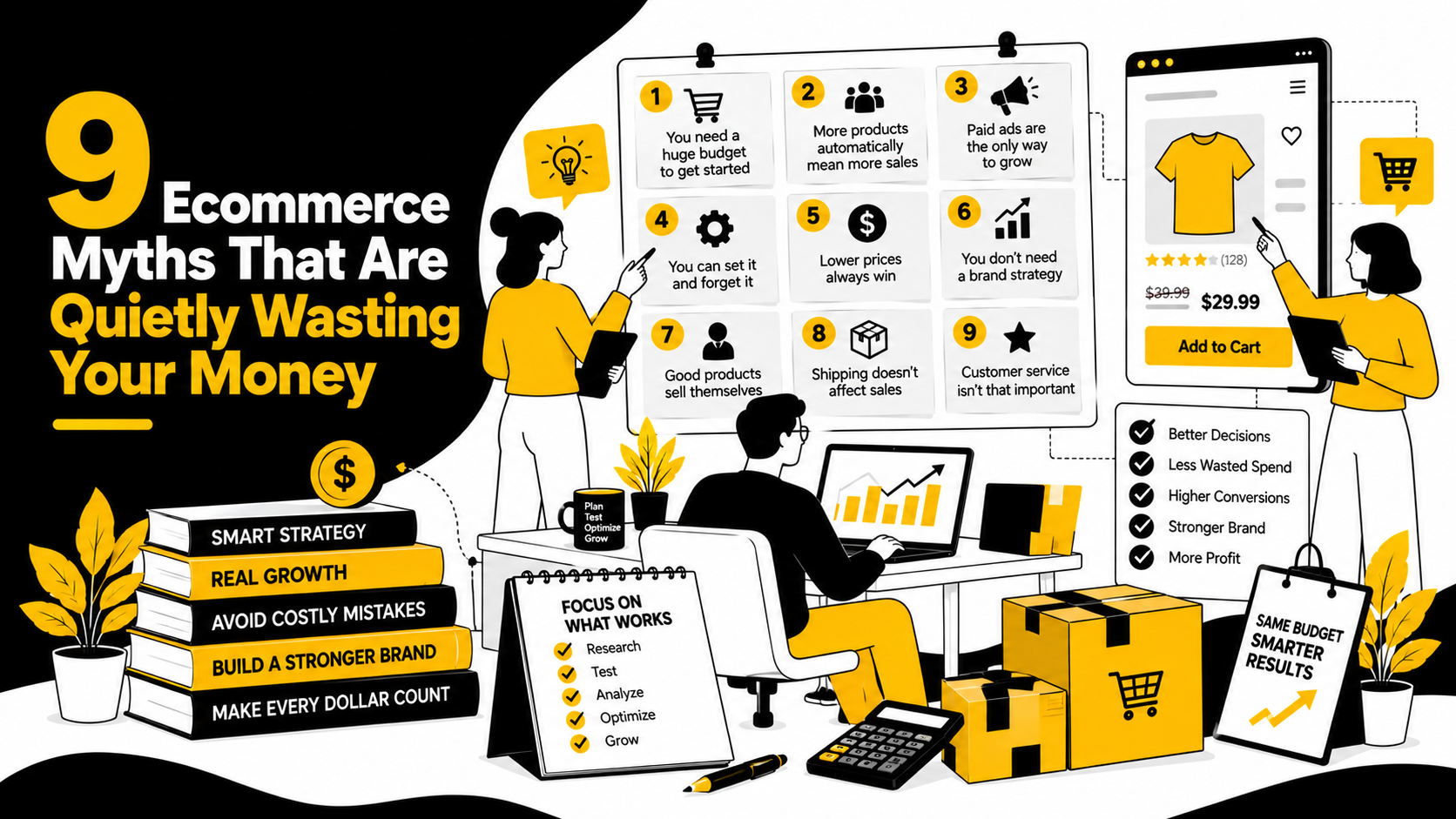
Here are nine myths worth dropping before they cost you.
Myth 1: “If I build it, customers will come.”
This is the most expensive myth of all. Spending Rs 40,000 on a beautiful store design means nothing if nobody visits it. Websites don’t attract visitors on their own.
The reality: Traffic is a separate job from building the store, and it usually takes longer.
What to do instead: Before you pay for design, decide where your first 100 visitors will come from. It could be your Instagram page, WhatsApp contacts, local groups, SEO content, or a small ad test. Split your time roughly equally between building and marketing.
Myth 2: “I need a huge product catalog.”
New sellers often list 200 products because a bigger store feels more professional. In practice, more products mean more inventory risk, more photography, more descriptions to write, and more customer questions.
The reality: Many successful stores start with 5 to 15 carefully chosen products.
What to do instead: Launch with a focused range, watch what actually sells, and add products based on real demand. If you dropship, test a few items before building your brand around them.
Myth 3: “The lowest price wins”
It’s tempting to undercut everyone. But large marketplaces and established brands can almost always go lower than you can, and a price war destroys your margin.
Say your product costs Rs 300 to source and ship. If you sell it at Rs 449 to beat competitors, you may have only Rs 149 left before ads, packaging, returns, and payment fees. One returned order can wipe out the profit from several sales.
The reality: Cheap pricing attracts bargain hunters who rarely come back.
What to do instead: Compete on things big sellers can’t match: a clear niche, better packaging, faster replies, honest product photos, and a personal touch.
Myth 4: “Paid ads will bring instant sales”
Ads don’t create demand for a weak offer. They send more people to a page that may not convince them. A common beginner pattern is spending Rs 15,000 on ads, getting 600 clicks, and making 2 sales, then concluding that “ads don’t work.”
The reality: Ads amplify what you already have. If the product page, price, and trust signals are weak, ads simply amplify the weakness.
What to do instead: Fix the basics first: clear photos, a strong description, delivery information, and a few reviews. Then test ads with a small daily budget, such as Rs 300 to Rs 500, and scale only what converts.
Myth 5: “A custom-built website is better than a platform”
Some beginners hire a developer to build a site from scratch, thinking it will look more unique and professional. It often costs several times more, takes months, and needs a developer for every small change.
The reality: Platforms like Shopify and WooCommerce already handle payments, security, mobile layouts, and updates, and they are used by stores of all sizes.
What to do instead: Start with a proven platform and customize with themes and apps. Consider custom development only when you have steady revenue and a specific need the platform genuinely can’t meet.
Myth 6: “Free shipping is always a must.”
Customers love free shipping, and it can lift conversions. But “free” is never actually free. If you don’t build the cost into your pricing, it comes straight out of your profit.
The reality: Free shipping works when it’s planned, not when it’s a reaction to competitors.
What to do instead: Include shipping cost in your product price, or offer free shipping above a threshold slightly higher than your average order value. For example, if customers usually spend Rs 700, set free shipping at Rs 899. This nudges people to add one more item.
Myth 7: “Social media followers equal sales”
A page with 20,000 followers feels like a business. But followers aren’t customers, and many of them may never see your posts, let alone buy.
The reality: A small, engaged audience often outsells a large, passive one. A page with 1,500 followers who comment, message, and ask about prices can be worth more than one with 20,000 silent ones.
What to do instead: Measure what matters: link clicks, direct messages, enquiries, and orders. Treat likes and follower counts as secondary numbers.
Myth 8: “Sales are the same as profit”
Seeing Rs 100,000 in monthly sales feels great until you subtract everything behind it: product cost, packaging, shipping, ad spend, payment gateway fees, returns, refunds, and GST.
Here’s a simple example:
- Sales: Rs 100,000
- Product cost: Rs 45,000
- Shipping and packaging: Rs 12,000
- Ads: Rs 20,000
- Returns and refunds: Rs 8,000
- Payment fees and other costs: Rs 3,000
- Actual profit: Rs 12,000
The reality: The number that matters is profit per order, not total sales.
What to do instead: Calculate your margin on each product before you scale. If a product only breaks even, more ad spend just means more work for no gain.
Myth 9: “I’ll set it up once, and it will run itself.”
Some people treat an online store like a vending machine: set it up, then wait. In reality, prices, offers, ads, product pages, and customer behavior all change over time.
The reality: Successful stores are tested and adjusted constantly.
What to do instead: Review your numbers weekly. Look at traffic, conversion rate, cart abandonment, and returns. Change one thing at a time, such as a headline, a photo, or an offer, so you know what actually made the difference.
A Quick Note: When These “Myths” Have Exceptions
Few rules in business are absolute. A large catalog works well for established marketplaces, and custom development makes sense for complex businesses with unusual requirements. Free shipping is essential in some product categories. The point isn’t that these ideas are always wrong, but that beginners often apply them too early and at the wrong scale.
Final Thoughts
Every myth above has the same cost: money spent before you’ve confirmed what actually works. The smartest approach for a new store is to start small, track your numbers honestly, and let real customer behavior guide your decisions.
You don’t need a perfect store or a big budget on day one. You need a good product, a clear way to reach customers, and a profit margin that holds up after every expense.