Running an ecommerce business in 2026 has never offered more technology—or created more confusion. Founders have access to AI assistants, powerful ecommerce apps, and skilled virtual assistants, yet many still feel overwhelmed by daily operations. Instead of saving time, they often find themselves switching between tools, fixing errors, and answering questions that automation was supposed to handle.
The reality is that success isn’t about using more software or replacing people with AI. It’s about creating a back-office system where AI, ecommerce apps, and ecommerce virtual assistants each play a specific role. When these three layers work together, operations become smoother, more predictable, and easier to scale.
This guide explains how successful ecommerce brands structure their back office in 2026—and why the right combination of technology and human expertise consistently outperforms relying on a single solution.
The New Back Office Stack in 2026
Modern ecommerce businesses no longer rely on one tool to manage everything. Instead, they build their operations around three connected layers.
AI
Artificial intelligence helps generate ideas, create first drafts, summarise information, and identify patterns. It speeds up work that would otherwise take hours.
Apps
Ecommerce applications automate repetitive processes, synchronise information across platforms, trigger workflows, and ensure routine tasks happen consistently without manual effort.
Virtual Assistants and Specialists
Ecommerce virtual assistants provide judgment, communication, coordination, and problem-solving. They oversee workflows, make informed decisions, and step in when automation reaches its limits.
Problems usually begin when businesses expect one of these layers—most commonly AI or a virtual assistant—to perform the work of all three. AI cannot replace human judgment, apps cannot think critically, and even the best virtual assistant shouldn’t spend their day performing tasks that automation could handle.
The strongest ecommerce operations understand where each layer delivers the most value.
What AI Is Good At—and What It Isn’t
Artificial intelligence has become an essential business tool, but understanding its strengths and limitations is critical.
Where AI Actually Helps in Ecommerce
AI delivers excellent results when speed matters more than perfection.
Some common ecommerce uses include:
- Drafting product descriptions
- Summarising customer reviews
- Creating first versions of SOPs
- Producing simple reports
- Generating customer support templates
- Brainstorming marketing ideas
- Categorising product data
AI is exceptionally good at recognising patterns and creating useful first drafts. It reduces repetitive writing and research work, allowing teams to move much faster.
Instead of spending thirty minutes creating a product description from scratch, AI can produce a solid starting point in seconds.
Where AI Still Needs a Human Layer
Despite rapid improvements, AI still struggles with situations requiring business judgment.
Examples include:
- Responding to sensitive customer complaints
- Maintaining a consistent brand voice
- Making pricing decisions
- Handling unusual order issues
- Interpreting marketplace policies
- Resolving supplier disputes
- Prioritising competing business needs
These tasks require experience, context, and decision-making that AI cannot consistently provide.
This is where ecommerce virtual assistants become essential. Rather than replacing AI, they review, improve, and apply AI-generated work while making informed decisions when exceptions arise.
The Role of Apps in a Smart Back Office
If AI creates information, ecommerce apps keep operations running.
Automating the Boring but Critical Work
Today’s ecommerce stores often rely on specialised apps to automate repetitive tasks across multiple sales channels.
Examples include:
- Inventory syncing between Shopify, Amazon, Etsy, Walmart, and eBay
- Order routing and fulfilment automation
- Shipping rule management
- Customer notifications
- Review collection
- Abandoned cart recovery
- CRM workflows
- Email marketing triggers
These systems remove hours of repetitive work while reducing manual errors.
Instead of updating inventory on every marketplace individually, one system synchronises stock automatically across all connected channels.
Why Apps Don’t Replace People
Apps only follow the rules they’re given.
They don’t decide which workflow makes the most sense. They don’t notice when processes no longer match business goals. They also can’t explain why something failed.
Someone still needs to:
- Select the right tools
- Configure workflows
- Monitor integrations
- Troubleshoot failures
- Clean product data
- Update automations as the business evolves
Automation makes work easier—but only when someone actively manages it.
Where Ecommerce Virtual Assistants Make the System Feel Human
Technology keeps operations moving, but people keep them working properly.
Coordinating AI and Apps
An experienced ecommerce virtual assistant connects all the moving parts.
They might:
- Review AI-generated product content before publishing
- Check automated inventory updates
- Monitor marketplace sync errors
- Escalate issues before customers notice
- Coordinate launches across multiple platforms
Rather than replacing technology, they make sure technology delivers reliable results.
Owning the “Gray Area” Work
Every ecommerce business encounters situations that don’t fit neatly into automation.
Examples include:
- Solving customer tickets that require empathy
- Correcting product listings with conflicting information
- Managing marketplace policy issues
- Updating SOPs as software changes
- Coordinating between suppliers, warehouses, and marketplaces
These tasks depend on judgment rather than rules, making them ideal responsibilities for trained ecommerce virtual assistants.
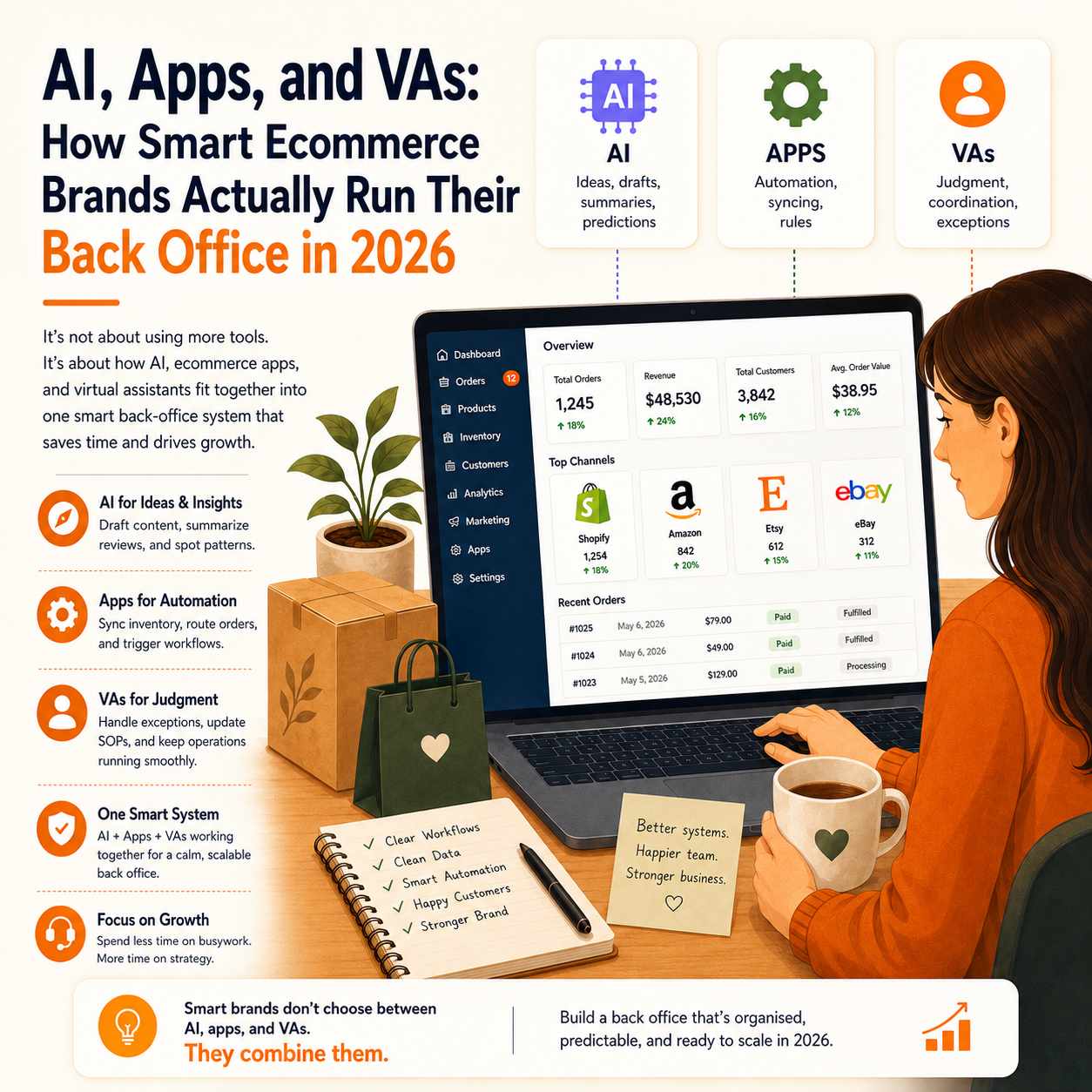
How Smart Brands Divide Work Between AI, Apps, and VAs
The most successful ecommerce businesses don’t ask one solution to do everything. Instead, they clearly divide responsibilities.
AI
Creates & Assists
- Drafts product content
- Generates ideas
- Summarises reports
- Spots patterns
- Creates first drafts
Apps
Automates & Syncs
- Syncs inventory
- Routes orders
- Sends notifications
- Runs workflows
- Triggers automation
Ecommerce VA
Reviews & Decides
- Reviews AI output
- Sets priorities
- Handles customers
- Solves exceptions
- Coordinates operations
Here’s a simple example of this approach:
A business launches a new product.
- AI drafts the product title, description, and key features.
- The ecommerce virtual assistant edits the content, improves SEO, checks accuracy, and ensures it matches the brand voice.
- The marketplace management app publishes the listing across multiple channels while automatically updating inventory.
Each layer focuses on what it does best.
Where EcommerceAlly Fits Into This Picture
At EcommerceAlly, the goal isn’t simply providing a virtual assistant.
Instead, the focus is on building a complete back-office system that works with the tools ecommerce businesses already use.
This includes:
- Ecommerce-trained virtual assistants
- Marketplace and operations specialists
- Shopify and marketplace support
- Product listing management
- Workflow documentation
- Process improvement
- Operational support that integrates with your existing software stack
Rather than adding more tools or expecting one person to solve every problem, EcommerceAlly helps businesses create systems that make daily operations more organised, efficient, and predictable.
That means founders spend less time fixing small issues and more time focusing on growth.
Signs Your Current Back Office Stack Isn’t Working
Your systems may need improvement if any of these sound familiar:
- You have AI tools, multiple apps, and a virtual assistant—but you’re still the operational bottleneck.
- Product data differs across marketplaces.
- Inventory regularly falls out of sync.
- You spend more time fixing small mistakes than reviewing business performance.
- Your ecommerce virtual assistant spends most of their day reacting to problems instead of following structured workflows.
- Every product launch feels stressful because processes change each time.
These aren’t usually staffing problems—they’re system problems.
First Steps to Modernise Your Back Office in 2026
Improving your operations doesn’t require replacing everything overnight.
Start with these practical steps:
- Map exactly what AI already does in your business—and identify where human review is still needed.
- Review every ecommerce app you’re paying for and remove tools that no longer provide value.
- Define a clear weekly ownership list for your ecommerce virtual assistant instead of assigning random daily tasks.
- Document three to five core workflows, such as order management, product listings, customer support tickets, and product launches.
- Decide which parts of each workflow belong to AI, which belong to automation apps, and which require human judgment.
- Review these workflows regularly as your business grows and new tools become available.
Small improvements across multiple workflows often deliver far greater results than introducing another new piece of software.
Frequently Asked Questions
Do I still need a virtual assistant if I’m using AI and automation apps?
Yes. AI and automation apps are excellent for handling patterns, repetitive tasks, and predefined rules. An ecommerce virtual assistant adds judgment, communication, quality control, and problem-solving when situations fall outside those rules.
What’s the biggest mistake ecommerce brands make with AI and VAs?
Many businesses expect either AI or a virtual assistant to handle everything. The strongest ecommerce brands divide responsibilities so AI creates, apps automate, and people make decisions.
How do I know if my back office stack is set up well?
A healthy back office allows daily operations to run smoothly without constant founder involvement. Your ecommerce virtual assistant should be following documented workflows, managing exceptions, and proactively keeping operations on track rather than waiting for instructions.
Conclusion
The most successful ecommerce businesses in 2026 aren’t choosing between AI, automation, and virtual assistants.
They’re combining them into a single operating system where every layer has a clear purpose.
AI accelerates work. Apps automate routine processes. Ecommerce virtual assistants provide the judgment, coordination, and flexibility that technology still can’t replicate.
The real competitive advantage isn’t having the latest tools. It’s creating a back office that feels organised, predictable, and ready to support long-term growth.
Treat your back office as a carefully designed system—not just a collection of disconnected tools and people—and every part of your ecommerce business becomes easier to manage.