When customers shop online, they cannot physically touch, test, or examine a product before making a purchase. They rely on product images, reviews, specifications, and written content to decide whether an item is right for them.
This makes product copywriting an important part of the ecommerce customer journey. Clear and persuasive product descriptions help shoppers understand what a product offers, how it can fit their needs, and why they should consider buying it. Product descriptions can also support search visibility, product-page performance, and customer conversions when written strategically.
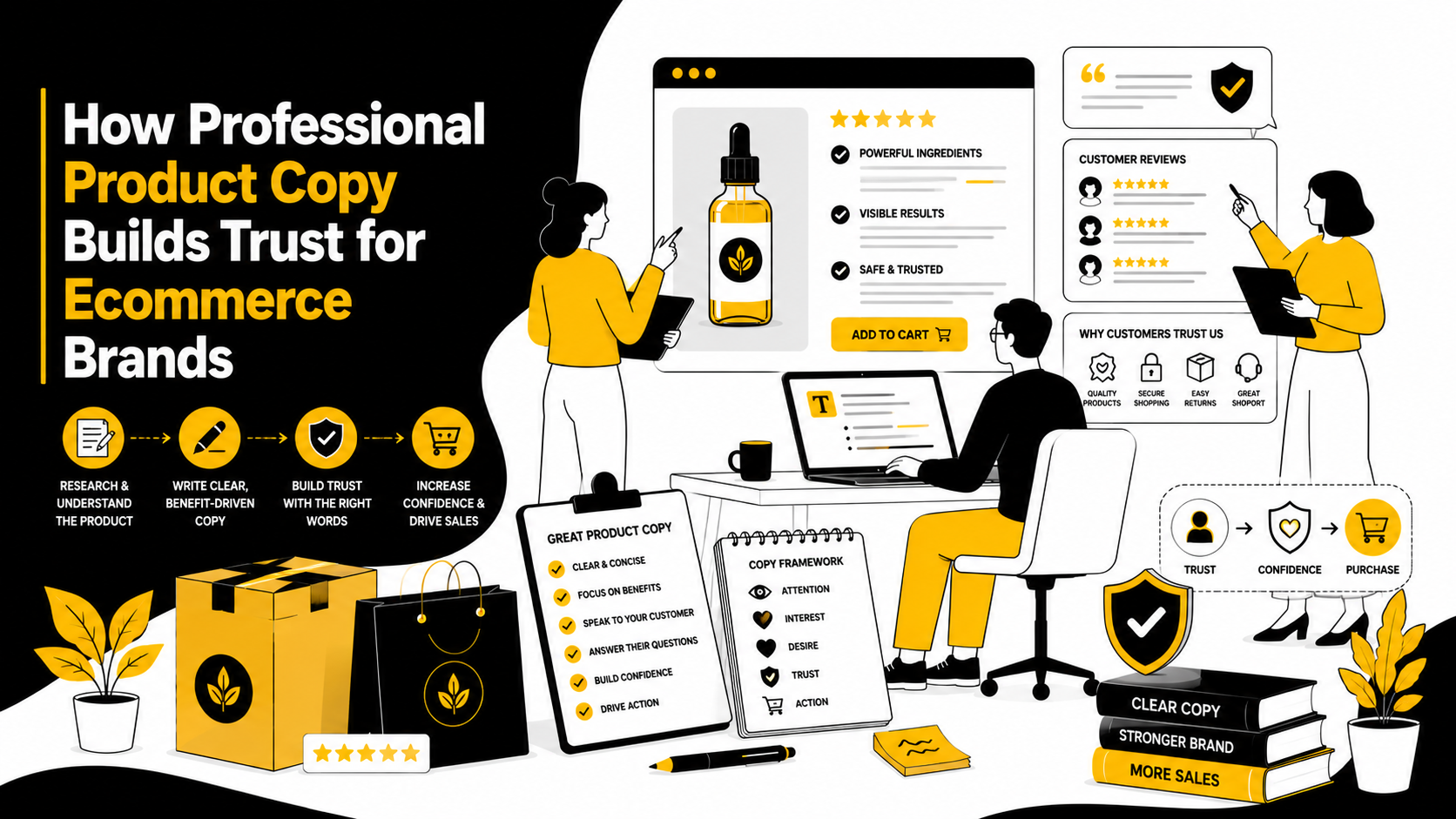
Professional product copy does more than describe an item. It builds confidence, answers questions, reduces uncertainty, and presents your brand as reliable.
Why Product Copy Builds Trust
Trust is essential in ecommerce because customers often make purchasing decisions without speaking directly to a salesperson. Your product page must provide enough information to help shoppers feel comfortable moving forward.
Weak product copy may leave customers wondering:
-
What exactly is this product?
-
How does it work?
-
Is it suitable for my needs?
-
What size or quantity will I receive?
-
How should I use it?
-
Is the product worth the price?
-
Can I trust this brand?
Professional ecommerce copywriting answers these questions in a clear and organized way.
It explains the product clearly
A strong product description tells customers what the item is without relying on vague phrases. Instead of using general claims such as “premium quality” or “the perfect choice,” effective product copy explains the product’s actual features, uses, materials, and benefits.
For example:
Weak copy:
A high-quality water bottle for everyone.
Improved copy:
A lightweight stainless-steel water bottle designed to keep drinks convenient to carry throughout the day.
The improved version gives the shopper more useful information while keeping the language simple.
It connects features with benefits
Features describe what a product has. Benefits explain why those features matter to the customer.
For example:
-
Feature: Double-wall stainless steel.
-
Benefit: Helps maintain the temperature of your drink for longer.
-
Feature: Leak-resistant lid.
-
Benefit: Makes the bottle easier to carry in a bag.
-
Feature: Compact design.
-
Benefit: Fits conveniently into most cup holders.
Customers usually care less about a technical feature on its own. They want to understand how that feature improves their experience.
It reduces uncertainty
Customers are more likely to hesitate when important product information is missing. Clear product copy can reduce confusion by including details about size, materials, compatibility, usage, care, shipping, and returns.
A product page should help shoppers find essential answers without searching through multiple pages or contacting customer support for basic information.
Essential Elements of Ecommerce Product Copy
Effective product copy is usually structured for quick reading. Online shoppers often scan a page before deciding whether to read it in detail.
A descriptive product title
The product title should identify the product and communicate its most important characteristic.
A useful format is:
Brand + Product Type + Key Feature + Use Case
For example:
EcommerceAlly Daily Hydration Serum with Hyaluronic Acid
This title is more informative than simply using:
Hydration Serum
A descriptive title can improve clarity for customers and help search engines understand the page. Product titles should include relevant information naturally without becoming overloaded with keywords.
A benefit-led introduction
The first sentence should quickly explain the product’s main value.
For example:
Designed for everyday use, this lightweight face serum helps support a simple and hydrating skincare routine.
The introduction should be specific to the product and audience. Avoid making promises that cannot be verified or supported.
Scannable product benefits
Use bullet points to highlight the most important benefits. This allows customers to understand the product quickly, especially when browsing on mobile devices.
For example:
-
Lightweight texture for comfortable daily use.
-
Easy-to-apply formula for simple routines.
-
Compact packaging suitable for travel.
-
Designed for customers who prefer a minimal skincare routine.
Every benefit should accurately reflect the product.
Features and specifications
Include the technical details customers may need before purchasing.
These may include:
-
Product dimensions.
-
Weight or quantity.
-
Ingredients or materials.
-
Color and size options.
-
Compatibility information.
-
Instructions for use.
-
Care instructions.
-
Package contents.
-
Storage requirements.
The most important information should not be hidden inside a long paragraph. Use headings, tables, or bullet points where appropriate.
Usage instructions
Customers should understand how to use the product correctly. Provide clear instructions based on the manufacturer’s guidance.
Depending on the product, this section may explain:
-
How much product to use.
-
When to use it.
-
How often to use it.
-
Which products it can be used with.
-
How to clean or maintain it.
-
How to store it safely.
Clear instructions can improve the customer experience and reduce avoidable questions.
Trust signals
Product copy becomes more convincing when supported by accurate trust signals. These may include:
-
Customer reviews.
-
Ratings.
-
Testimonials.
-
Frequently asked questions.
-
Return information.
-
Product guarantees.
-
Secure payment details.
-
Relevant certifications.
Social proof is commonly used in product descriptions because reviews and testimonials can help reduce customer hesitation.
Do not add false reviews, exaggerated claims, or certifications that the product does not have. Trust signals work only when customers can rely on them.
How to Write Product Copy That Converts
Professional product copy should combine customer research, brand voice, search intent, and accurate product information.
Understand the target customer
Before writing, identify who is most likely to buy the product.
Consider:
-
What problem does the customer want to solve?
-
What features matter most to them?
-
What concerns may prevent them from buying?
-
What language do they use when searching?
-
What alternatives are they comparing?
-
What would make them feel confident?
A product description for a busy parent will not sound the same as one written for a professional athlete or a luxury skincare customer.
Use natural ecommerce keywords
SEO keywords should fit naturally into the copy. Relevant phrases may include:
-
Ecommerce product copy.
-
Product description writing.
-
Product listing optimization.
-
Ecommerce content writing.
-
Product page copywriting.
-
Online store content.
Avoid repeating the same keyword in every sentence. Keyword stuffing can make the writing unnatural and can reduce readability.
Instead, use related phrases in logical locations, including:
-
Product titles.
-
Headings.
-
Opening paragraphs.
-
Feature bullets.
-
Image alt text.
-
Meta descriptions.
-
Frequently asked questions.
The main goal is to help both search engines and customers understand the page.
Match the brand voice
Every product page should sound like it belongs to the same business. A luxury brand may use refined and polished language, while a family-focused brand may use a warmer and more conversational tone.
Define guidelines for:
-
Preferred words.
-
Sentence length.
-
Tone.
-
Capitalization.
-
Product naming.
-
Calls to action.
-
Words or claims to avoid.
A consistent brand voice helps customers recognize your business across product pages, emails, packaging, and other marketing channels.
Write for mobile shoppers
Many ecommerce customers browse products on mobile devices. Long paragraphs and complicated layouts can make product information difficult to read.
Make product copy easier to scan by using:
-
Short paragraphs.
-
Clear headings.
-
Bullet points.
-
Simple sentences.
-
Important details near the top.
-
Collapsible sections for additional information.
A well-written description should remain useful whether the customer reads it on a desktop computer, tablet, or smartphone.
Use specific calls to action
A call to action should guide the customer toward the next step. Examples include:
-
Add the product to your cart.
-
Choose your preferred size.
-
Select a color.
-
Start your daily routine.
-
Order today.
-
Explore the complete collection.
The call to action should match the customer’s stage in the buying journey and should not make unrealistic promises.
Product Copy Example
Consider a fictional white-label skincare product.
Basic version
Glow Face Serum
This is a premium serum that gives your skin amazing results. It is made with quality ingredients and is perfect for everyone.
Improved version
Daily Hydrating Face Serum with Hyaluronic Acid
Add lightweight hydration to your daily skincare routine with this easy-to-apply face serum. Its compact bottle makes it convenient for everyday use, while the simple formula fits easily into morning or evening routines.
Key benefits:
-
Lightweight texture.
-
Easy-to-apply formula.
-
Suitable for a simple daily routine.
-
Convenient 30 ml bottle.
-
Ideal for customers who prefer minimal skincare steps.
The improved version is more effective because it explains what the product is, identifies its main feature, describes how it fits into a routine, and presents the information in a format that is easy to scan.
Common Product Copy Mistakes
Even good products can appear less valuable when their descriptions are unclear or incomplete.
Using manufacturer copy without editing
Supplier descriptions are often generic and may be used by several businesses. Copying them word for word can make your product page sound similar to competitors.
Create original content that reflects your brand, target audience, and positioning.
Focusing only on features
A list of ingredients, materials, or technical specifications may not explain why customers should care. Connect important features with practical customer benefits.
Making unsupported claims
Avoid claims related to health, safety, sustainability, performance, or guaranteed results unless they are accurate and properly supported.
Writing long blocks of text
Large paragraphs can hide important information. Break the content into sections so customers can find answers quickly.
Ignoring product variations
If a product is available in several sizes, colors, flavors, or models, make sure the copy clearly explains the differences.
Forgetting frequently asked questions
FAQs can address common concerns about sizing, usage, compatibility, delivery, returns, and product care. They can also reduce repetitive customer service questions.
Failing to update old information
Prices, product features, packaging, stock details, and policies can change over time. Review product copy regularly to keep it accurate.
How EcommerceAlly Can Help
Writing effective product copy requires more than describing a product. It involves understanding customer needs, researching relevant search terms, following a consistent brand voice, and organizing information for easy reading.
EcommerceAlly can support online businesses with:
-
Ecommerce copywriting.
-
Product description writing.
-
Product listing optimization.
-
Product title creation.
-
Website content writing.
-
Brand voice development.
-
Product page content.
-
Marketplace listing updates.
-
Ecommerce content writing.
Professional product copy can help your brand communicate more clearly and create a stronger customer experience. When shoppers understand what you offer and why it is relevant to them, they can make purchasing decisions with greater confidence.
Final Thoughts
Product copy is one of the most important communication tools available to an ecommerce brand. It introduces the product, explains its benefits, answers customer questions, and reflects the reliability of the business behind it.
Clear ecommerce product copy should be accurate, easy to scan, customer-focused, and consistent with the brand’s identity. It should also support product listing optimization without sacrificing natural, helpful writing.
Whether you sell white-label products, handmade items, digital products, or branded merchandise, professional product copy can help turn a basic listing into a more persuasive shopping experience.
With the right ecommerce copywriting strategy, your product pages can inform customers, build trust, and help your brand stand out in a competitive online marketplace.