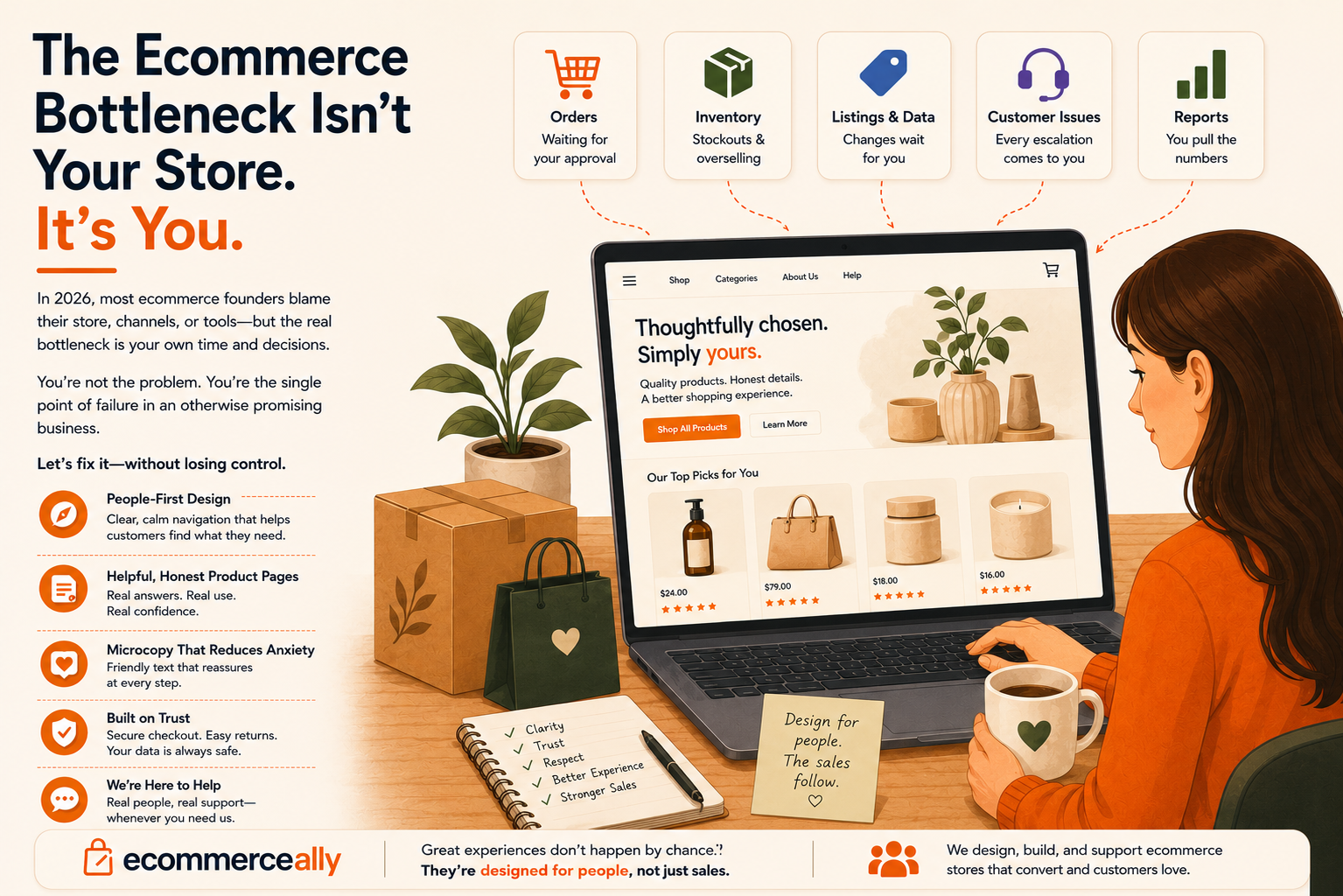
In 2026, ecommerce founders have more tools than ever before. AI helps create content, automation apps manage repetitive tasks, and marketplaces make it easier to sell across multiple channels. Yet many business owners still feel like growth has slowed.
The first instinct is often to blame the website, advertising, rising competition, or another software platform. But for many growing ecommerce brands, the real bottleneck isn’t the store—it’s the founder’s time and decision-making.
This isn’t about saying you’re the problem. It’s about recognising that you’ve become the single point of failure in an otherwise promising business. When every important decision, approval, or exception depends on you, even a well-built operation struggles to move quickly.
The good news is that this is fixable. In this guide, you’ll learn how to recognise the signs of a founder bottleneck and how to remove yourself from day-to-day operations without giving up control of your business.
What “Founder Bottleneck” Really Means in Ecommerce
When Every Path Leads Back to You
A founder bottleneck happens when too many approvals, decisions, and operational tasks must pass through one person before work can continue.
It usually doesn’t happen overnight. As the business grows, founders naturally become involved in everything—from approving product listings to resolving customer complaints and checking inventory.
Over time, every workflow begins to wait for one person.
Common signs include:
- Projects constantly waiting for approval
- Slow responses to customers or suppliers
- Team members asking for permission before acting
- The founder continually adding “just one more thing” before work is finished
- Daily operations slowing whenever the founder is unavailable
Instead of the business running independently, every path eventually leads back to you.
Why It Shows Up Between ~$500K and ~$2M
In the early stages of an ecommerce business, founder involvement is a competitive advantage. You’re close to customers, understand every product, and can make quick decisions.
But as revenue grows—typically between $500K and $2M annually—operations become more complex.
You’re managing:
- Multiple marketplaces
- More products
- Larger inventories
- Customer support
- Paid advertising
- Suppliers
- A growing team
At this stage, founder-only management starts slowing everything down. What once helped the business grow now becomes the biggest obstacle to scaling.
The Hidden Costs of Being the Bottleneck
Growth That Feels Busy, Not Profitable
Many founders confuse activity with progress.
Revenue increases, more orders arrive, and new opportunities appear—but profit doesn’t improve at the same pace.
Why?
Because bottlenecks create hidden costs, including:
- Delayed product launches
- Missed sales opportunities
- Rush shipping costs
- Refunds from operational mistakes
- Discounting to solve preventable issues
- Inefficient workflows that waste time
The business gets busier without becoming significantly more profitable.
Stress That Scales Faster Than Revenue
Perhaps the biggest hidden cost is personal.
As the company grows, the founder becomes the escalation point for almost everything.
Support tickets.
Inventory problems.
Marketplace issues.
Supplier questions.
Team decisions.
Urgent customer requests.
Instead of focusing on strategy, product development, and growth, the founder spends most of the day solving operational problems.
Scaling stress is not the same as scaling a business.
How to Tell If You’re the Bottleneck (Simple Checks)
Ask yourself these questions honestly.
- Who approves new products before they go live?
- Who signs off on pricing changes or promotions?
- Who fixes problems when orders, inventory, or listings break?
- Who handles unusual customer requests or escalations?
- How many important decisions in a typical week cannot happen without you?
If your answer is “me” to most of these questions, you’ve become the operational bottleneck.
The Systems That Break First in Ecommerce
Order and Fulfillment Flow
Order processing often breaks first.
Typical warning signs include:
- Manual order batching
- Founder approval before replacements or refunds
- Shipping delays caused by waiting for decisions
- Fulfillment exceptions piling up
Customers don’t see the internal delays—they simply experience slower service.
Inventory, Listings, and Data
Inventory problems usually follow.
When product information lives inside the founder’s head—or scattered across personal spreadsheets—it becomes difficult for the rest of the team to keep everything accurate.
This often leads to:
- Stockouts
- Overselling
- Duplicate listings
- Incorrect product information
- Marketplace inconsistencies
Reliable systems require shared processes, not founder memory.
Customer Service and Edge Cases
Customer support also becomes increasingly difficult.
Every unusual request gets escalated.
Special discounts.
Shipping exceptions.
Refund approvals.
Replacement decisions.
Over time, these “special cases” become normal, leaving the founder responsible for hundreds of unnecessary decisions each month.
Why Founders Stay Stuck in Operations
Fear of Losing Quality and Control
Many founders believe:
“If I don’t check it, something will go wrong.”
That concern is understandable.
After all, you’ve built the business.
But this mindset often keeps founders trapped inside daily operations, reviewing every task instead of improving the systems behind those tasks.
Eventually, protecting quality turns into protecting bottlenecks.
Undocumented Knowledge and Missing Roles
Another common problem is undocumented knowledge.
Many businesses rely on processes that exist only inside the founder’s head.
The team knows what to do—but not exactly how or when to do it.
At the same time, ownership is often unclear.
Everyone helps.
Nobody owns.
Without clear responsibilities, every important task eventually returns to the founder.
The Shift From “Founder Does” to “System Owns”
Clarifying Roles and Ownership
Scaling requires moving from individual effort to documented systems.
Instead of asking who can help with orders or customer support, define who owns each workflow.
Ownership should exist for:
- Orders
- Inventory
- Product listings
- Customer tickets
- Weekly reporting
Process owners should be able to make routine decisions without waiting for founder approval.
Documenting the 5 Core Workflows
Start by documenting these essential ecommerce workflows:
1. Order to Delivery
Define every step from purchase through fulfillment and delivery.
2. Inventory Updates and Sync
Create a standard process for updating stock across every sales channel.
3. Product and Listing Changes
Document how products are created, edited, reviewed, and published.
4. Customer Service Escalation
Clearly define which issues can be solved by the team and which require founder involvement.
5. Weekly Reporting and Review
Standardise reporting so performance is reviewed on a schedule—not only when problems appear.
The goal isn’t perfection.
It’s making sure your business can continue operating without depending on you for every decision.
Where Ecommerce Virtual Assistants and Specialists Fit
Taking Over Execution, Not Vision
An ecommerce founder should still own the vision.
But daily execution doesn’t need to stay on their desk.
Ecommerce-trained virtual assistants and operations specialists can manage documented workflows, monitor systems, maintain listings, coordinate customer support, and keep operations moving.
The founder remains focused on:
- Brand growth
- Product strategy
- Marketing direction
- Business development
Instead of processing tasks.
Building a Back Office That Works Without You
A reliable ecommerce operation combines:
- Skilled ecommerce virtual assistants
- Automation apps
- Clear SOPs
- Defined ownership
- Regular reporting
Together, these turn unpredictable daily work into repeatable routines.
At EcommerceAlly, we help ecommerce businesses build these operational systems by combining ecommerce-trained virtual assistants, marketplace specialists, and proven workflows that integrate with your existing tools. The goal isn’t simply adding more people—it’s creating a back office that keeps moving even when you’re focused elsewhere.
Practical Steps to Remove Yourself as the Bottleneck
Start with these practical actions:
- List every task that currently stops until you respond.
- Group those tasks into workflows such as orders, inventory, listings, support, and reporting.
- Decide who should own each workflow—whether that’s an internal employee, ecommerce virtual assistant, or specialist partner.
- Create a simple SOP for every workflow. It doesn’t need to be perfect; it just needs to be clear.
- Give workflow owners authority to make routine decisions within defined rules.
- Replace constant interruptions with structured weekly reporting.
Small improvements in ownership often create massive improvements in speed.
Frequently Asked Questions
1. How do I stay in control if I’m not involved in every decision?
Control comes from clear ownership, documented processes, and regular reporting. Instead of approving every task, you review outcomes and performance on a consistent schedule.
2. What if my team isn’t ready for more responsibility?
Start with one workflow. Give the team clear instructions, decision guidelines, and support from an experienced ecommerce virtual assistant or specialist. As confidence grows, expand ownership gradually.
3. Is this only a problem for larger ecommerce businesses?
No. Founder bottlenecks usually appear once a business manages multiple products, sales channels, or team members—even if annual revenue is still in the mid-six figures.
Conclusion
You are not the problem.
But if every important decision depends on you, you have become the bottleneck.this size is perfect !!
The good news is that bottlenecks are created by systems—and systems can be improved.
By defining ownership, documenting workflows, empowering your team, and using ecommerce virtual assistants alongside smart automation, your business can continue growing without waiting for your approval at every step.
The next stage of growth begins when your ecommerce business can move confidently without you managing every detail—allowing you to focus on the strategic decisions that only you can make.