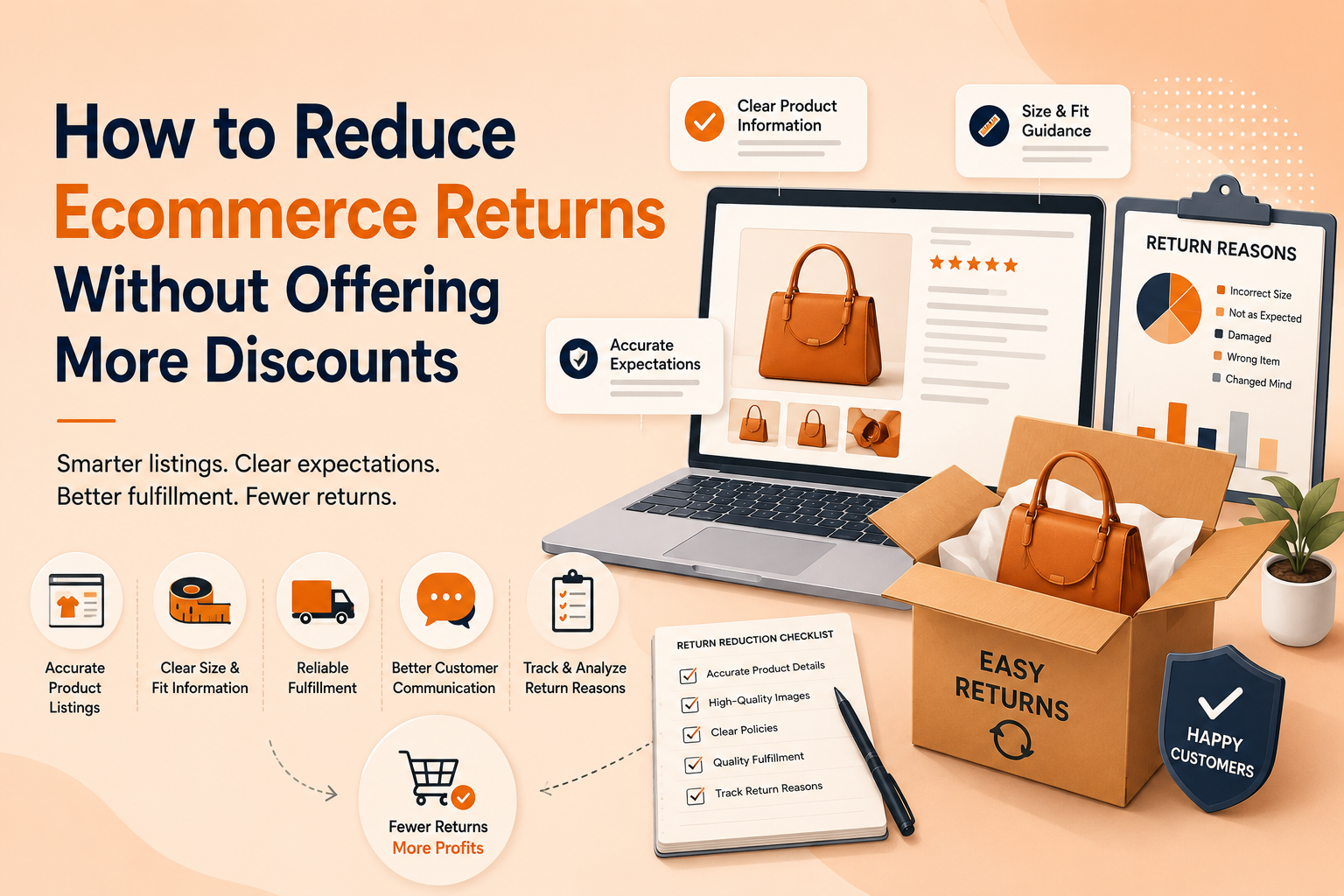
Frequent product returns are one of the biggest profit killers for ecommerce businesses. Every returned order comes with additional costs—from return shipping and restocking to refund processing and customer support. Even when a returned item can be sold again, the time and resources spent handling the return reduce your overall profitability.
Many store owners respond by offering more discounts or promotions, hoping customers will keep their purchases. However, discounts rarely address the real reasons customers return products. Most returns happen because expectations don’t match reality, products arrive damaged, the wrong item is shipped, or customers lack the information they need before buying.
The good news is that you can significantly reduce product returns without cutting into your margins. By improving product listings, setting realistic expectations, strengthening your fulfillment process, and organizing your ecommerce returns management, you can create a better customer experience while protecting your profits.
In this guide, you’ll learn practical ecommerce return reduction strategies that work for Shopify stores, Amazon sellers, and other ecommerce businesses.
Why Ecommerce Stores Get Too Many Returns
Understanding why customers return products is the first step in learning how to reduce ecommerce returns.
Product Expectations Do Not Match Reality
This is one of the most common reasons customers request refunds.
Customers rely entirely on your product page when making a purchase decision. If your listing contains vague descriptions, overly edited images, or exaggerated marketing claims, buyers may receive something very different from what they expected.
Common issues include:
- Incomplete product descriptions
- Missing specifications
- Poor-quality images
- Incorrect colors due to editing
- Missing compatibility information
- Overpromising product performance
The better your product information, the fewer surprises customers experience after delivery.
Incorrect Size or Fit
Sizing issues account for a large percentage of returns, especially in fashion, footwear, furniture, and accessories.
Customers often struggle because of:
- Generic size charts
- Missing measurements
- Inconsistent sizing
- No fit guidance
- Limited customer feedback
Instead of guessing, customers should have enough information to confidently choose the correct size before ordering.
Product Damage or Fulfillment Errors
Even a perfect product listing cannot prevent returns caused by warehouse mistakes.
These include:
- Wrong product shipped
- Incorrect product variant
- Missing accessories
- Damaged packaging
- Poor packing materials
- Delayed deliveries
These errors frustrate customers and often lead to refunds instead of exchanges.
Customers Change Their Minds
Not every return is caused by a mistake.
Impulse purchases, unclear return policies, or a lack of post-purchase communication can all increase return requests.
Sending helpful emails after purchase and setting clear expectations can often prevent unnecessary returns.
Improve Product Listings Before Customers Buy
Your product pages should answer every question a customer might ask before clicking “Buy Now.”
Write Accurate Product Descriptions
Good product descriptions reduce uncertainty.
Include:
- Exact dimensions
- Materials used
- Compatibility information
- Product limitations
- Care instructions
- Assembly requirements
- What’s included inside the package
Avoid vague marketing language. Customers appreciate honesty more than exaggerated claims.
For example, instead of saying:
“Premium oversized blanket.”
Write:
“Measures 150 × 200 cm and comfortably fits one adult or two children.”
Specific information builds trust.
Use Better Product Images and Videos
Customers cannot touch or inspect products online.
Help them visualize the item using:
- Multiple viewing angles
- Lifestyle images
- Close-up product details
- Scale comparison photos
- Texture shots
- Demonstration videos
- Accurate color representation
Showing products from every angle reduces surprises after delivery.
Add Comparison Charts and Buying Guides
Comparison tables make buying decisions easier.
Instead of customers ordering three similar products to compare at home, they can compare features directly on your website.
Include comparisons for:
- Sizes
- Materials
- Features
- Compatibility
- Recommended use
- Weight
- Capacity
Buying guides also help customers choose the correct option the first time.
Make Size and Fit Information Easier to Understand
If you sell products with sizing or fitting requirements, your product pages should remove all guesswork.
Best practices include:
- Add detailed measurement instructions.
- Use product-specific size charts.
- Include actual garment or product measurements.
- Explain whether the fit is slim, regular, or relaxed.
- Show model height and size where applicable.
- Highlight customer reviews discussing fit.
Instead of saying:
“Choose your usual size.”
Write:
“Model is 178 cm tall and wears a Medium. This shirt has a slim fit. If you prefer a looser fit, order one size larger.”
Clear sizing information can dramatically reduce product returns.
Set Clear Customer Expectations
Be Transparent About Delivery Times
Customers appreciate realistic timelines more than unrealistic promises.
Display:
- Dispatch times
- Estimated delivery dates
- Courier updates
- Tracking information
Unexpected delays often result in unnecessary cancellations and returns.
Explain Product Limitations
Honesty builds trust.
Mention:
- Color variations
- Assembly requirements
- Compatibility restrictions
- Maintenance requirements
- Battery requirements
- Weather limitations
Customers are less likely to return products when they understand these details before purchasing.
Display Return Policies Clearly
Your return policy should be easy to find.
Display it on:
- Product pages
- Cart page
- Checkout page
- Order confirmation emails
- Website footer
Customers shouldn’t have to search for return information after purchasing.
Prevent Fulfillment and Packaging Errors
Even the best product page cannot prevent warehouse mistakes.
Improve your fulfillment process by:
- Verifying SKUs before dispatch
- Double-checking product variants
- Using pre-shipping quality-control checklists
- Adding protective packaging
- Including manuals and accessories
- Tracking recurring warehouse mistakes
Small improvements in packing and verification can significantly lower return rates.
Use Customer Feedback to Find Return Patterns
Every return provides valuable information.
Instead of simply processing refunds, analyze why customers return products.
Review:
- Return reasons
- Product-level return rates
- Customer support conversations
- Product reviews
- Refund comments
- Delivery complaints
This data helps identify recurring issues that can be fixed.
Create a Return-Reason Report
Tracking return reasons makes it easier to prioritize improvements.
| Product | Return Reason | Number of Returns | Estimated Cost | Recommended Action |
|---|---|---|---|---|
| Product A | Incorrect size | 24 | ₹X | Improve size chart |
| Product B | Damaged in transit | 12 | ₹X | Upgrade packaging |
| Product C | Not as expected | 18 | ₹X | Rewrite product description |
Review this report weekly or monthly to identify trends before they become expensive problems.
How Ecommerce VAs Can Help Reduce Returns
Managing returns involves much more than processing refunds.
A trained virtual assistant for ecommerce returns can help prevent problems before they occur.
An Ecommerce VA can:
- Audit product listings
- Update specifications
- Improve size charts
- Monitor customer questions
- Categorize return reasons
- Track delayed deliveries
- Follow up on incorrect shipments
- Review product feedback
- Coordinate replacements
- Prepare weekly return reports
Instead of spending hours analyzing returns yourself, an Ecommerce VA keeps your product information accurate while identifying opportunities to improve customer satisfaction.
This proactive approach supports long-term ecommerce returns management and helps reduce avoidable return costs.
Improve Post-Purchase Communication
Your relationship with the customer shouldn’t end after checkout.
Helpful communication can prevent many unnecessary returns.
Consider sending:
- Order confirmation with product details
- Shipping confirmation with tracking information
- Product setup or installation instructions
- Care and maintenance guidance
- Follow-up email asking whether the customer needs assistance
Many customers return products simply because they don’t know how to use them correctly.
A timely email can solve problems before they become refund requests.
What Not to Do When Managing Returns
Avoid these common mistakes:
- Do not hide your return policy.
- Do not blame customers for every return.
- Do not continue selling products with repeated quality complaints.
- Do not use heavily edited images that misrepresent products.
- Do not make refunds unnecessarily difficult.
- Do not focus only on return volume—track return reasons and financial impact as well.
The goal is not just fewer returns but better customer experiences.
Ecommerce Return-Reduction Checklist
Use this checklist to review your store regularly:
- ✅ Product specifications are complete.
- ✅ Images accurately represent the product.
- ✅ Size or compatibility information is clear.
- ✅ Delivery timelines are realistic.
- ✅ Packaging protects the product.
- ✅ SKUs are verified before dispatch.
- ✅ Return reasons are tracked.
- ✅ Negative reviews are monitored regularly.
- ✅ Customer questions receive quick responses.
- ✅ Product pages are updated based on return data.
Reviewing this checklist monthly can help identify issues before they affect your profits.
Conclusion
Reducing returns doesn’t require bigger discounts or more aggressive promotions. It starts long before the customer places an order.
Accurate product listings, clear size information, realistic delivery expectations, reliable fulfillment, and ongoing analysis of return data all contribute to lower return rates and higher customer satisfaction.
By implementing these ecommerce return reduction strategies, you’ll not only reduce unnecessary refunds but also improve customer trust and increase long-term profitability.
Need help managing product listings, customer queries, and return-related ecommerce tasks? Contact Ecommerce Ally to connect with a skilled ecommerce virtual assistant and build a more efficient ecommerce business.
Frequently Asked Questions
How can I reduce ecommerce returns?
Improve product descriptions, use accurate images, provide detailed size or compatibility information, strengthen fulfillment processes, and regularly analyze return reasons to identify recurring issues.
Do better product descriptions reduce returns?
Yes. Detailed, accurate, and realistic product descriptions help customers understand exactly what they are buying, reducing misunderstandings and preventing avoidable returns.
How can ecommerce VAs help with returns?
An Ecommerce VA can update product listings, monitor customer questions, track return reasons, coordinate replacements, review customer feedback, and prepare performance reports to improve ecommerce returns management.
What is the most common reason for ecommerce returns?
Common reasons include incorrect size or fit, products that don’t match customer expectations, damaged items, fulfillment mistakes, and delayed deliveries.
Should I make my return policy stricter?
Not necessarily. A clear, transparent, and fair return policy builds customer trust. The focus should be on preventing avoidable returns rather than making the return process more difficult.