You’ve built your store, listed your products, and set aside $500 for marketing. Now comes the question every new seller faces: do you put it all into ads, or invest in organic growth like content, social media, and SEO?
Both work, but in different ways. Spending your first $500 in the wrong place can mean weeks of wasted effort. Here’s how to decide.
What’s the Difference?
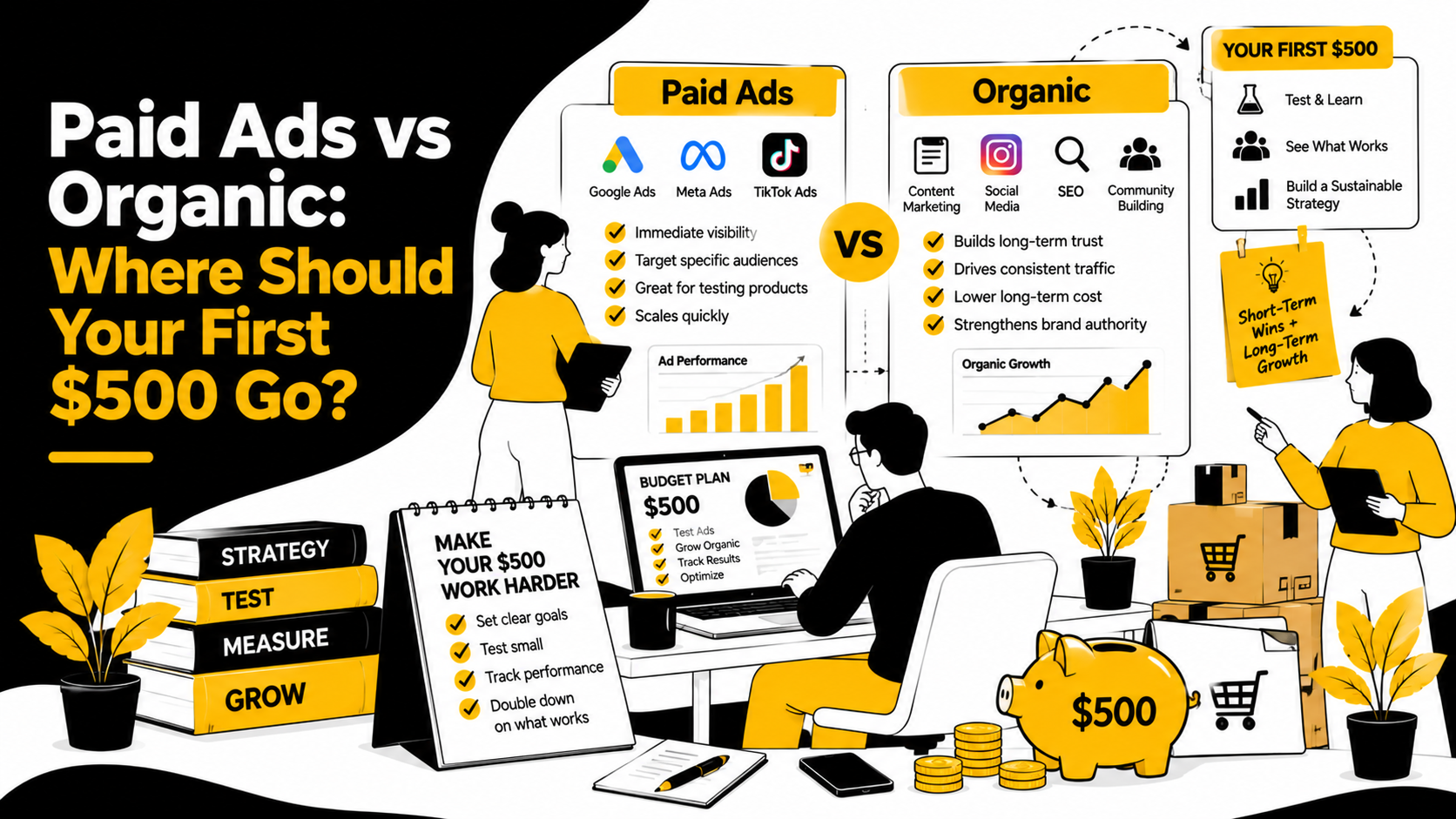
Paid marketing means paying for visibility: Meta (Instagram and Facebook) ads, TikTok ads, Google Shopping, or sponsored influencer posts. Results come fast, but when you stop paying, the traffic stops.
Organic marketing means earning visibility without paying per click: SEO, blog content, short-form video, email lists, community groups, and word of mouth. Results are slower, but they compound over time.
Paid Ads: Pros and Cons
Pros
- Traffic starts within hours
- Precise targeting by country, age, interests, and behavior
- Fast feedback on whether people want your product
- Easy to scale once something works
Cons
- Costs rise with competition, especially around Q4 and holiday sales
- Beginners often waste money on weak targeting and creatives
- Nothing is left behind when the budget ends
- A weak product page makes ads very expensive
Organic Marketing: Pros and Cons
Pros
- Low cash cost
- Builds trust and brand recognition
- Keeps bringing visitors long after you publish
- Creates assets you own, like an email list and a content library
Cons
- Slow, often 3 to 6 months for SEO
- Requires consistency
- Less predictable results
- Videos and posts can get little reach for no obvious reason
The Real Deciding Factors
1. How much time do you have?
If you have more time than money, lean organic. If you have more money than time, ads can speed things up, provided your store is ready to convert.
2. Is your product page ready?
Clear photos, a strong description, shipping and returns information, and some social proof come first. Otherwise you’re paying to send people to a page that doesn’t convince them.
3. What are you selling?
- Visual, impulse-friendly products (fashion, jewelry, home decor, gifts): TikTok, Instagram Reels, and Pinterest, plus small ad tests.
- Products people search for (specific tools, supplements, replacement parts): SEO and Google Shopping have the edge.
- High-consideration items (furniture, electronics): reviews, comparison content, and trust matter more than quick ads.
4. What’s your margin?
If you make $8 profit per order and each sale costs you $10 in ads, you lose money on every order. Know your numbers before you advertise. With thin margins, organic channels are safer.
A Sample $500 Budget Split
There’s no universal formula, but this is a sensible starting point:
- Meta or TikTok ads (testing): $200. Test 2 to 3 products or creatives at $15 to $20 per day for about 10 days.
- Content creation: $125. Better product photos, short videos, or a freelancer for UGC-style clips.
- Email and SMS setup: $50. Klaviyo, Mailchimp, or similar tools to capture and follow up with visitors.
- Micro-influencer or giveaway: $75. Free products to 3 to 5 small creators in your niche.
- Reserve: $50. Retargeting ads or doubling down on whatever works.
Why this split? It treats ads as a testing tool, not a magic switch. Most of the remaining money goes into assets (content, contacts, trust) that keep paying off.
A Simple 30-Day Plan
Week 1: Improve product pages. Set up email capture with a welcome discount. Post 3 to 4 times on your main social channel.
Week 2: Start small ad tests. Run two or three creatives and track cost per click, add-to-cart rate, and purchases.
Week 3: Switch off what isn’t working. Move the remaining budget to the best performer. Send samples to micro-influencers.
Week 4: Retarget visitors who didn’t buy. Review profit per order. Decide how to split next month’s budget.
Common Mistakes to Avoid
- Putting the whole $500 into ads in week one. You’ll have no data and no budget left to act on it.
- Judging results too early. Give each test at least 3 to 5 days, since ad platforms need time to learn.
- Ignoring email. Paid traffic you don’t capture is gone forever.
- Going organic only with no plan. Random posting without a clear offer rarely produces sales.
- Not tracking anything. Install your Meta Pixel, TikTok Pixel, and Google Analytics before spending a dollar.
- Forgetting regional rules. If you sell to the EU or UK, set up cookie consent and privacy compliance (GDPR) before running tracking and ads.
When Each Approach Wins
Go mostly paid if you have a proven product, healthy margins, and a polished store. Go mostly organic if your budget is very limited, your niche is search-driven, or you need to build trust first. For most beginners, a mix works best: ads to learn quickly, organic to build something lasting.
Final Thoughts
The question isn’t really “paid or organic?” It’s “what do I need to learn first?” Your first $500 should buy information: which product people want, which message works, and which channel brings profitable customers.
Treat your first budget as tuition, not a bet. The goal is to finish knowing exactly where your next $500 should go.
Want a ready-made marketing budget tracker? Download our free template and track every dollar from day one.